

Languages:


Context - Dibutyl Phthalate (DBP) is used in a wide range of products for everyday use such as plastics, paints, inks and cosmetics.
Its widespread use has raised some concerns on the safety of this compound. Is DBP posing a risk to health or the environment?


This Digest is a faithful summary of the leading scientific consensus report produced in 2003 by the European Chemicals Bureau (ECB): "
Phthalates are widely used as additives in a range of plastics and other materials that are found in many consumer products. They make plastics, such as PVC, soft and flexible. They are not chemically bound to plastics, so they can be released from consumer products into the environment. There is public concern about phthalates because of their widespread use and occurrence in the environment as well as their potential effects on human health.
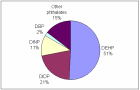
There is a wide range of different phthalates, which each have specific properties, uses, and health effects. In the European Union, five of the most widely used phthalates have been reviewed by the European Chemicals Bureau (DEHP, DBP, DINP, DIDP, and BBP).
By 2004, EU Risk Assessment Reports had been published for three of these phthalates: DIDP, DINP, and DBP; assessements which have been summarised by GreenFacts. Because of the strong similarities between the first two phthalates, they are described together. More...
DBP is a phthalate with the same core structure as DIDP and DINP but with two shorter side chains attached, each having four carbon atoms. It is an oily liquid that is soluble in fat and to some extent in water. More...
DBP has been produced for more than 40 years. In 1998, around 26 000 tonnes were produced annually in the European Union but (in contrast to DIDP and DINP) its production is going down. Like DIDP and DINP, it is used mainly as a plasticiser in PVC that is used to make, film, sheeting, coated products, flooring, roofing, wall coverings, hoses, tubing, wires, cables, injection moulded shoe soles, car undercoating and sealants. Non-PVC uses are in adhesives, sealants, paints, printing inks, lubricants, nail polish, and perfumes, as a suspension agent for solids in aerosols and in preventing foaming. More...
3.1 DBP as free chemical does not break down in water but does break down in soil. More...
3.2 DBP can be released at different stages: production, distribution, processing, use, incineration and disposal. More...
3.3 High DBP concentrations in the environment are mostly found near by production and processing sites in waste water and nearby surface water. DBP is also found in sediment and soil, and in aquatic and soil-dwelling organisms near to sources. The highest levels in air occur around PVC processing plants. More...
3.4 When DBP is present, it does not appear to have adverse effects on most organisms in the environment. It is not toxic to microbes, plants or animals living in water, or to earthworms and flies. On land, plants can be adversely affected by DBP present in the atmosphere. More...
3.5 The European Union Risk Assessment Report (the source of the present summary) concluded that predicted concentrations in air around DBP production facilities could affect plant life and that further risk reduction measures need to be taken. More...
Exposure of humans may occur from DBP present in the environment, workplace or consumer products. More...
4.1 The highest exposures can occur in workplaces where DBP or DBP-containing products are produced or used. Workers are mainly exposed through the air they breathe or through skin contact. More...
4.2 Exposure of the general public is much lower and can occur through consumer products and food packaging containing DBP. Exposure of children can occur through plastic toys and baby equipment. More...
4.3 For the general public, the total daily intake through air, drinking water and food is estimated to be low including around local production and use sites. DBP has been identified in breast milk at relatively low concentrations. More...
DBP is well absorbed by the body following ingestion or contact with the skin. The extent of absorption when DBP is breathed in is not known but it is likely to be well absorbed. In laboratory animals (as for DIDP and DINP) DBP mainly affects the liver but humans are thought to be much less sensitive to these liver effects. DBP also reduces the number and birth weight of rat offspring. Studies on developing rats show that DBP adversely affects development of the reproductive system in males. It also affects the nasal cavity in rats when DBP is breathed in. More...
Human exposures are compared with the lowest amounts needed to cause effects in laboratory animals to determine the margin of safety. More...
6.1 Workers are considered to be at risk in some situations including repeated breathing in of DBP during the production or use of products containing DBP and repeated skin exposure during the use of products containing DBP in situations where DBP is formed as an aerosol.
It is concluded that in these situations there is a need for risk reduction measures but it is noted that adequate worker protection may already be in place in some industrial premises. More...
6.2 Exposure of the general public is lower than that of workers, and adults, newborns, infants and children are not considered to be at risk. This conclusion applies not only to general exposure via the environment and food but also to specific scenarios such as regular use of nail polish or DBP-containing adhesives and infants exposed to PVC toys and baby equipment. More...
It is concluded that:
Phthalates have played an important role in the creation of plastics and other materials that have many versatile uses in industry, in medicine and in consumer products.
In view of more recent research and raising concerns about possible environmental and health effects, the risks of exposure to phthalates are being kept under close review by national and international bodies.
The most recent EU reviews on DIDP, DINP and DBP conclude that:
Other phthalates are currently being assessed by the European Chemicals Bureau.
GreenFacts comment:
Other EU reviews are currently underway and the information will be posted on this website as soon as it becomes available:


Introduction: What are phthalates?

This summary is free and ad-free, as is all of our content. You can help us remain free and independant as well as to develop new ways to communicate science by becoming a Patron!


 BECOME A PATRON!