Langues:

Surface ReflectivitySea ice covered with snow reflects about 85-90% of sunlight, while ocean water reflects just 10%. Thus, as sea ice melts, revealing more and more of the ocean beneath, the increasing absorption of solar radiation adds to global warming, which causes more melting, which in turn causes more warming, and so on… 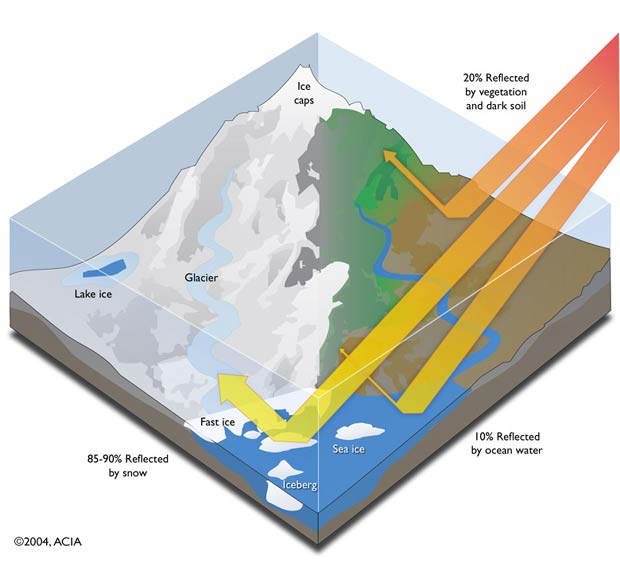 Source : ACIA Impacts of a Warming Arctic: Arctic Climate Impact Assessment Publication apparentée :
Other Figures & Tables on this publication : Observed Arctic Temperature, 1900 to Present Observed sea ice September 1979 and September 2003 Projected Vegetation, 2090-2100 Arctic Thermohaline Circulation Projected Arctic Surface Air Temperatures Projected opening of northern navigation routes Factors influencing UV at the surface 1000 years of changes in carbon emissions Projected Surface Air Temperature change 1990-2090 |