Forest and Cultivated systems
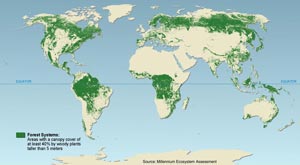
"Forest systems are lands dominated by trees; they are often used for timber, fuelwood, and non-timber forest products. The map shows areas with a canopy cover of at least 40% by woody plants taller than 5 meters. Forests include temporarily cut-over forests and plantations but exclude orchards and agroforests where the main products are food crops. The global area of forest systems has been reduced by one half over the past three centuries. Forests have effectively disappeared in 25 countries, and another 29 have lost more than 90% of their forest cover. Forest systems are associated with the regulation of 57% of total water runoff. About 4.6 billion people depend for all or some of their water on supplies from forest systems. From 1990 to 2000, the global area of temperate forest increased by almost 3 million hectares per year, while deforestation in the tropics occurred at an average rate exceeding 12 million hectares per year over the past two decades.
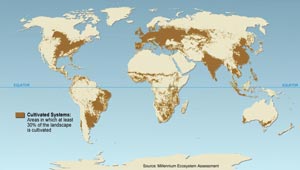
Cultivated systems are lands dominated by domesticated species and used for and substantially changed by crop, agroforestry, or aquaculture production. The map shows areas in which at least 30% by area of the landscape comes under cultivation in any particular year. Cultivated systems, including croplands, shifting cultivation, confined livestock production, and freshwater aquaculture, cover approximately 24% of total land area. In the last two decades, the major areas of cropland expansion were located in Southeast Asia, parts of South Asia, the Great Lakes region of eastern Africa, the Amazon Basin, and the U.S. Great Plains. The major decreases of cropland occurred in the southeastern United States, eastern China, and parts of Brazil and Argentina. Most of the increase in food demand of the past 50 years has been met by intensification of crop, livestock, and aquaculture systems rather than expansion of production area. In developing countries, over the period 1961–99 expansion of harvested land contributed only 29% to growth in crop production, although in sub-Saharan Africa expansion accounted for two thirds of growth in production. Increased yields of crop production systems have reduced the pressure to convert natural ecosystems into cropland, but intensification has increased pressure on inland water ecosystems, generally reduced biodiversity within agricultural landscapes, and it requires higher energy inputs in the form of mechanization and the production of chemical fertilizers. Cultivated systems provide only 16% of global runoff, although their close proximity to humans means that about 5 billion people depend for all or some of their water on supplies from cultivated systems. Such proximity is associated with nutrient and industrial water pollution."
Source & ©
Millennium Ecosystem Assessment
 Synthesis Report (2005),
Chapter 1, pp.29-30
Related publication:
Other Figures & Tables on this publication:
Box 3.1 Table. Selected Water-related Diseases.
Table 1.1. Comparative table of reporting systems as defined by the Millennium Assessment
Table 2.1. Trends in the Human Use of Ecosystem Services and Enhancement or Degradation of the Service Around the Year 2000 - Provisioning services
Table 2.1. Trends in the Human Use of Ecosystem Services and Enhancement or Degradation of the Service Around the Year 2000 - Regulating services
Table 2.1. Trends in the Human Use of Ecosystem Services and Enhancement or Degradation of the Service Around the Year 2000 - Cultural services
Table 2.1. Trends in the Human Use of Ecosystem Services and Enhancement or Degradation of the Service Around the Year 2000 - Supporting services
Table 2.2. Indicative Ecosystem Service Trade-offs.
Table 5.1. Main Assumptions Concerning Indirect and Direct Driving Forces Used in the MA Scenarios
Table 5.2. Outcomes of Scenarios for Ecosystem
Services in 2050 Compared with 2000
Table 5.3. Outcomes of Scenarios for Human Well-being in 2050 Compared with 2000
Table 5.4. Costs and Benefits of Proactive as Contrasted with Reactive Ecosystem Management as Revealed in the MA Scenarios
Table 8.1. Applicability of Decision Support Methods and Frameworks
Marine, Coastal, and Island Systems
Urban, Dryland and Polar systems
Forest systems
Cultivated systems
Inland water and Mountain systems
Box Figure B. Proportion of Population with Improved Drinking Water Supply in 2002
Box Figure C. Proportion of population with improved sanitation coverage in 2002
Figure 1.2. Conversion of Terrestrial Biomes
Figure 1.3. Decline in Trophic Level of Fisheries Catch Since 1950
Figure 1.4. Locations reported by various studies as undergoing high rates of land cover change in the past few decades.
Figure 1.5. Global Trends in the Creation of Reactive Nitrogen on Earth by Human Activity, with Projection to 2050
Figure 1.7. Growth in Number of Marine Species Introductions.
Figure 1.8. Species Extinction Rates
Figure 3.4. Collapse of Atlantic Cod Stocks Off the East Coast of Newfoundland in 1992
Figure 3.5. Dust Cloud Off the Northwest Coast of Africa, March 6, 2004
Figure 3.6. Changes in Economic Structure for Selected Countries
Figure 3.7. Human Population Growth Rates, 1990-2000, and Per Capita GDP and Biological Productivity in 2000 in MA Ecological Systems
Figure 4.1. GDP Average Annual Growth, 1990-2003
Figure 4.2. Per capita GDP Average Annual Growth, 1990-2003
Figure 4.3. Main Direct Drivers of Change in Biodiversity and Ecosystems
Figure 5.1. MA World Population Scenarios
Figure 5.3. Number of Ecosystem Services Enhanced or Degraded by 2050 in the Four MA Scenarios
Figure 6.1. MA Sub-Global Assessments
Figure 7.1. Characteristic Time and Space Scales Related to Ecosystems and Their Services
Box 3.1. Linkages between Ecosystem Services and Human Well-being
Box 6.1 Local Adaptations of MA Conceptual Framework
Scenarios of the Millennium Ecosystem Assessment
MA Scenarios - Global Orchestration
MA Scenarios - Order from Strength
MA Scenarios - TechnoGarden
MA Scenarios - Adapting Mosaic
Marine, Coastal and Island systems
Urban, Dryland and Polar systems
Forest and Cultivated systems
Inland waters and Mountain systems
MA Systems
Box 2.1: Ecosystem Services
Box 2.1: Ecosystem Services
Box 3.2. Ecosystems and the Millennium Development Goals
Box 3.1. Linkages between Ecosystem Services and Human Well-being:
Basic Materials for a Good Life
Box 3.1. Linkages between Ecosystem Services and Human Well-being:
Health
Box 3.1. Linkages between Ecosystem Services and Human Well-being:
Good Social Relations
Box 3.1. Linkages between Ecosystem Services and Human Well-being:
Security
Box 3.1. Linkages between Ecosystem Services and Human Well-being:
Freedom of Choice and Action
Box 6.1 Local Adaptations of MA Conceptual Framework
Figure 1.1. Time Series of Intercepted Continental Runoff and Large Reservoir Storage, 1900-2000
Figure 1.6. Estimated Total Reactive Nitrogen Deposition from the Atmosphere
Figure 2.1. Estimated Global Marine Fish Catch, 1950-2001.
Figure 2.2. Trend in Mean Depth of Catch Since 1950.
Figure 3.1. Net National Savings Adjusted for Investments in Human Capital, Natural Resource Depletion, and Damage Caused by Pollution compared with Standard Net National Savings Measurements
Figure 3.2. Annual Flow of Benefits from Forests in Selected Countries
Figure 3.3. Economic Benefits Under Alternate Management Practices
Table 4.1. Increase in Nitrogen Fluxes in Rivers to Coastal Oceans
Figure 5.2. Comparison of Global River Nitrogen Export
Figure 5.4. Number of Undernourished Children Projected in 2050 Under MA Scenarios
Figure 5.5. Net Change in Components of Human Well-being Between 2000 and 2050 Under MA Scenarios.
Figure 8.1. Total Carbon Market Value per Year (in million dollars nominal)