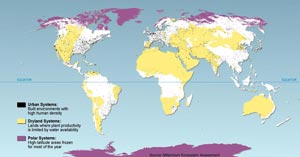
Urban, Dryland and Polar systems
"Urban systems are built environments with a high human density. For mapping purposes, the MA uses known human settlements with a population of 5,000 or more, with boundaries delineated by observing persistent night-time lights or by inferring areal extent in the cases where such observations are absent. The world’s urban population increased from about 200 million in 1900 to 2.9 billion in 2000, and the number of cities with populations in excess of 1 million increased from 17 in 1900 to 388 in 2000.
Dryland systems are lands where plant production is limited by water availability; the dominant human uses are large mammal herbivory, including livestock grazing, and cultivation. The map shows drylands as defined by the U.N. Convention to Combat Desertification, namely lands where annual precipitation is less than two thirds of potential evapotranspiration—from dry subhumid areas (ratio ranges 0.50–0.65) through semiarid, arid, and hyperarid (ratio < 0.05), but excluding polar areas. Drylands include cultivated lands, scrublands, shrublands, grasslands, savannas, semi-deserts, and true deserts. Dryland systems cover about 41% of Earth’s land surface and are inhabited by more than 2 billion people (about one third of the total population). Croplands cover approximately 25% of drylands, and dryland rangelands support approximately 50% of the world’s livestock. The current socioeconomic condition of people in dryland systems, of which about 90% are in developing countries, is worse than in other areas. Freshwater availability in drylands is projected to be further reduced from the current average of 1,300 cubic meters per person per year in 2000, which is already below the threshold of 2,000 cubic meters required for minimum human well-being and sustainable development. Approximately 10–20% of the world’s drylands are degraded (medium certainty).
Polar systems are high-latitude systems frozen for most of the year, including ice caps, areas underlain by permafrost, tundra, polar deserts, and polar coastal areas. Polar systems do not include high-altitude cold systems in low latitudes. Temperature in polar systems is on average warmer now than at any time in the last 400 years, resulting in widespread thaw of permafrost and reduction of sea ice. Most changes in feedback processes that occur in polar regions magnify trace gas–induced global warming trends and reduce the capacity of polar regions to act as a cooling system for Earth. Tundra constitutes the largest natural wetland in the world."
Source & ©
Millennium Ecosystem Assessment
 Synthesis Report (2005),
Chapter 1, pp.27-29
Related publication:
Other Figures & Tables on this publication:
Box 3.1 Table. Selected Water-related Diseases.
Table 1.1. Comparative table of reporting systems as defined by the Millennium Assessment
Table 2.1. Trends in the Human Use of Ecosystem Services and Enhancement or Degradation of the Service Around the Year 2000 - Provisioning services
Table 2.1. Trends in the Human Use of Ecosystem Services and Enhancement or Degradation of the Service Around the Year 2000 - Regulating services
Table 2.1. Trends in the Human Use of Ecosystem Services and Enhancement or Degradation of the Service Around the Year 2000 - Cultural services
Table 2.1. Trends in the Human Use of Ecosystem Services and Enhancement or Degradation of the Service Around the Year 2000 - Supporting services
Table 2.2. Indicative Ecosystem Service Trade-offs.
Table 5.1. Main Assumptions Concerning Indirect and Direct Driving Forces Used in the MA Scenarios
Table 5.2. Outcomes of Scenarios for Ecosystem
Services in 2050 Compared with 2000
Table 5.3. Outcomes of Scenarios for Human Well-being in 2050 Compared with 2000
Table 5.4. Costs and Benefits of Proactive as Contrasted with Reactive Ecosystem Management as Revealed in the MA Scenarios
Table 8.1. Applicability of Decision Support Methods and Frameworks
Marine, Coastal, and Island Systems
Urban, Dryland and Polar systems
Forest systems
Cultivated systems
Inland water and Mountain systems
Box Figure B. Proportion of Population with Improved Drinking Water Supply in 2002
Box Figure C. Proportion of population with improved sanitation coverage in 2002
Figure 1.2. Conversion of Terrestrial Biomes
Figure 1.3. Decline in Trophic Level of Fisheries Catch Since 1950
Figure 1.4. Locations reported by various studies as undergoing high rates of land cover change in the past few decades.
Figure 1.5. Global Trends in the Creation of Reactive Nitrogen on Earth by Human Activity, with Projection to 2050
Figure 1.7. Growth in Number of Marine Species Introductions.
Figure 1.8. Species Extinction Rates
Figure 3.4. Collapse of Atlantic Cod Stocks Off the East Coast of Newfoundland in 1992
Figure 3.5. Dust Cloud Off the Northwest Coast of Africa, March 6, 2004
Figure 3.6. Changes in Economic Structure for Selected Countries
Figure 3.7. Human Population Growth Rates, 1990-2000, and Per Capita GDP and Biological Productivity in 2000 in MA Ecological Systems
Figure 4.1. GDP Average Annual Growth, 1990-2003
Figure 4.2. Per capita GDP Average Annual Growth, 1990-2003
Figure 4.3. Main Direct Drivers of Change in Biodiversity and Ecosystems
Figure 5.1. MA World Population Scenarios
Figure 5.3. Number of Ecosystem Services Enhanced or Degraded by 2050 in the Four MA Scenarios
Figure 6.1. MA Sub-Global Assessments
Figure 7.1. Characteristic Time and Space Scales Related to Ecosystems and Their Services
Box 3.1. Linkages between Ecosystem Services and Human Well-being
Box 6.1 Local Adaptations of MA Conceptual Framework
Scenarios of the Millennium Ecosystem Assessment
MA Scenarios - Global Orchestration
MA Scenarios - Order from Strength
MA Scenarios - TechnoGarden
MA Scenarios - Adapting Mosaic
Marine, Coastal and Island systems
Urban, Dryland and Polar systems
Forest and Cultivated systems
Inland waters and Mountain systems
MA Systems
Box 2.1: Ecosystem Services
Box 2.1: Ecosystem Services
Box 3.2. Ecosystems and the Millennium Development Goals
Box 3.1. Linkages between Ecosystem Services and Human Well-being:
Basic Materials for a Good Life
Box 3.1. Linkages between Ecosystem Services and Human Well-being:
Health
Box 3.1. Linkages between Ecosystem Services and Human Well-being:
Good Social Relations
Box 3.1. Linkages between Ecosystem Services and Human Well-being:
Security
Box 3.1. Linkages between Ecosystem Services and Human Well-being:
Freedom of Choice and Action
Box 6.1 Local Adaptations of MA Conceptual Framework
Figure 1.1. Time Series of Intercepted Continental Runoff and Large Reservoir Storage, 1900-2000
Figure 1.6. Estimated Total Reactive Nitrogen Deposition from the Atmosphere
Figure 2.1. Estimated Global Marine Fish Catch, 1950-2001.
Figure 2.2. Trend in Mean Depth of Catch Since 1950.
Figure 3.1. Net National Savings Adjusted for Investments in Human Capital, Natural Resource Depletion, and Damage Caused by Pollution compared with Standard Net National Savings Measurements
Figure 3.2. Annual Flow of Benefits from Forests in Selected Countries
Figure 3.3. Economic Benefits Under Alternate Management Practices
Table 4.1. Increase in Nitrogen Fluxes in Rivers to Coastal Oceans
Figure 5.2. Comparison of Global River Nitrogen Export
Figure 5.4. Number of Undernourished Children Projected in 2050 Under MA Scenarios
Figure 5.5. Net Change in Components of Human Well-being Between 2000 and 2050 Under MA Scenarios.
Figure 8.1. Total Carbon Market Value per Year (in million dollars nominal)