

Languages:

The source document for this Digest states:
IDENTIFICATION OF THE SUBSTANCE
CAS No: 84-74-2
EINECS No: 201-557-4
IUPAC name: dibutyl phthalateSynonyms: di-n-butylphthalat, 1,2-Benzenedicarboxylic acid, dibutyl ester (9CI), Phthalic acid, dibutyl ester (6CI, 8CI), Bis-n-butyl phthalate, Butyl phthalate, DBP, DBP (ester), Dibutyl o-phthalate, Di(n-butyl) 1,2-benzenedicarboxylate, n-Butyl phthalate, Palatinol C, Phthalic acid di-n-butyl ester
Molecular weight: 278.34
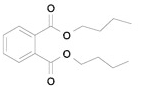
Molecular formula: C16H22O4Structural formula:
PURITY/IMPURITIES, ADDITIVES
Purity: >99% (w/w)
Impurity: ca. 0.01% (w/w) butan-1-ol
ca. 0.01% (w/w) butyl benzoate
Additives: nonePHYSICO-CHEMICAL PROPERTIES
Physical state: oily liquid
Melting point: - 69°C
Boiling point: 340°C at 1,013 hPa
Relative density: 1.045 g/cm3 at 20°C
Vapour pressure: 9.7 + 3.3.10-5 hPa at 25°C
Water solubility: 10 mg/l at 20°C
Partition coefficient
n-octanol/water: log Kow 4.57
Granulometry: not applicable
Flammability: negative
Explosive properties: negative
Oxidizing properties: negativeThese data are mainly derived from Banerjee and Howard (1984), BASF (corporate data), BUA (1987), Hoyer and Pepperle (1958), Hüls (corporate data); Leyder and Boulanger (1983), Patty (1981). For an extended description see the IUCLID database.
CLASSIFICATION Classification and labelling according to the 28th ATP of Directive 67/548/EEC3: Classification: Repr. Cat. 2; R61 May cause harm to the unborn child Repr. Cat. 3; R62 Possible risk of impaired fertility N; R50 Dangerous for the environment: very toxic to aquatic organisms
Labelling: T; N
R: 61-50-62
S: 53-45-61No Note
Specific concentration limits: none
Source & ©:

For more information, see the full ECB
Risk Assessment Report:



This summary is free and ad-free, as is all of our content. You can help us remain free and independant as well as to develop new ways to communicate science by becoming a Patron!

 BECOME A PATRON!