

Languages:

Particulate matter is the sum of all solid and liquid particles suspended in air many of which are hazardous. This complex mixture includes both organic and inorganic particles, such as dust, pollen, soot, smoke, and liquid droplets. These particles vary greatly in size, composition, and origin.
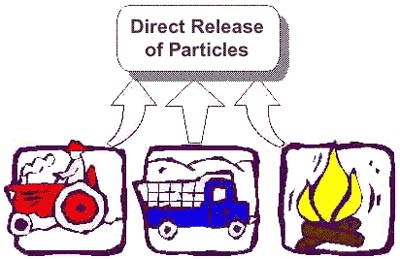
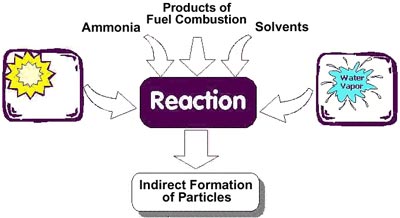
Particles in air are either:


The aerodynamic properties of particles determine how they are transported in air and how they can be removed from it. These properties also govern how far they get into the air passages of the respiratory system. Additionally, they provide information on the chemical composition and the sources of particles.
Particles have irregular shapes and their aerodynamic behaviour is expressed in terms of the diameter of an idealised sphere. The sampling and description of particles is based on this aerodynamic diameter, which is usually simply referred to as ‘particle size’. Particles having the same aerodynamic diameter may have different dimensions and shapes. Some airborne particles are over 10,000 times bigger than others in terms of aerodynamic diameter.
Based on size, particulate matter is often divided into two main groups:
Most of the total mass of airborne particulate matter is usually made up of fine particles ranging from 0.1 to 2.5 µm. Ultrafine particles often contribute only a few percent to the total mass, though they are the most numerous, representing over 90% of the number of particles. More...
Coarse particles are produced by the mechanical break-up of larger solid particles. The coarse fraction can include dust from roads, agricultural processes, uncovered soil or mining operations, as well as non-combustible materials released when burning fossil fuels. Pollen grains, mould spores, and plant and insect parts can also contribute to the coarse fraction. Finally, evaporation of sea spray can produce large particles near coasts.
Fine particles are largely formed from gases. Ultrafine particles (up to 0.1 µm) are formed by nucleation, which is the initial stage in which gas becomes a particle. These particles can grow up to a size of 1 µm either through condensation, when additional gas condensates on the particles, or through coagulation, when two or more particles combine to form a larger particle. Particles produced by the intermediate reactions of gases in the atmosphere are called secondary particles.
Combustion of fossil fuels such as coal, oil, and petrol can produce
On average, the two main components of particulate matter in Europe are sulphate and organic matter. This is true both for fine particles (PM2.5) and for coarse and fine particles combined (PM10).
However, near roads mineral dust is also a main component of PM10.
On days when the levels of particulate matter in the air are high (PM10 exceeds 50 µg/m3), nitrate is also a major component of both PM10 and PM2.5.
Soot, also referred to as black carbon, makes up 5 to10% of fine particles and somewhat less of coarse particles; near certain roads the proportion of soot can reach 15 to 20%. More...



This summary is free and ad-free, as is all of our content. You can help us remain free and independant as well as to develop new ways to communicate science by becoming a Patron!


 BECOME A PATRON!