

Languages:

The source document for this Digest states:
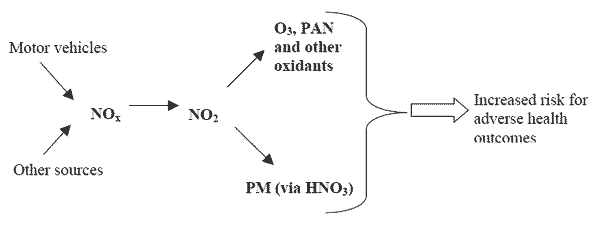
As for PM and O3, the evidence on NO2 and health comes from different sources of information, including observational epidemiology, controlled human exposures to pollutants and animal toxicology. The observational data are derived from studies outdoors where NO2 is one component of the complex mixture of different pollutants found in ambient air and from studies of NO2 exposure indoors where its sources include unvented combustion appliances. Interpretation of evidence on NO2 exposures outdoors is complicated by the fact that in most urban locations, the nitrogen oxides that yield NO2 are emitted primarily by motor vehicles, making it a strong indicator of vehicle emissions (including other unmeasured pollutants emitted by these sources). NO2 (and other nitrogen oxides) is also a precursor for a number of harmful secondary air pollutants, including nitric acid, the nitrate part of secondary inorganic aerosols and photo oxidants (including ozone). The situation is also complicated by the fact that photochemical reactions take some time (depending on the composition of the atmosphere and meteorological parameters) and air can travel some distance before secondary pollutants are generated. These relationships are shown schematically in Figure 1.
Figure 1: Simplified relationship of nitrogen oxides emissions with formation of NO2 and other harmful reaction products including O3 and PM
Health risks from nitrogen oxides may potentially result from NO2 itself or its reaction products including O3 and secondary particles. Epidemiological studies of NO2 exposures from outdoor air are limited in being able to separate these effects. Additionally, NO2 concentrations closely follow vehicle emissions in many situations so that NO2 levels are generally a reasonable marker of exposure to traffic related emissions.
Given these complex relationships, findings of multivariate models that include NO2 and other pollutants need cautious interpretation. While multi-pollutant models have been routinely applied to various forms of observational data, they may mis-specify underlying relationships. Even models that include only NO2 and PM, NO2 and O3, or NO2, PM and O3 do not reflect the interrelationships among these pollutants. Statistical models considering interactions must be based on a strong a priori hypothesis about the nature of these interactions to allow their interpretation. With these constraints in mind, the working group recommended against using regression coefficients for NO2 from regression models for the purpose of quantitative risk assessment.
Evidence of the health effects of NO2 by itself thus comes largely from toxicological studies and from observational studies on NO2 exposure indoors. The studies of outdoor NO2 may be most useful under the following circumstances:
Source & ©: WHO Regional Office for Europe



This summary is free and ad-free, as is all of our content. You can help us remain free and independant as well as to develop new ways to communicate science by becoming a Patron!

 BECOME A PATRON!