

Languages:

Context - In the high layers of the atmosphere, Ozone acts as a protective sunscreen that shields us from the high levels of UV radiation coming from the sun. At ground-level, however, it can be harmful to plants, animals, and humans. How are we exposed to ozone and how harmful can it be?


This Digest is a faithful summary of two leading scientific consensus reports produced in 2003 and 2004 by the World Health Organization (WHO): "
Ozone (O3) is a gas that can form and react under the action of light and that is present in two layers of the atmosphere. High up in the atmosphere, ozone forms a layer that shields the Earth from ultraviolet rays. However, at ground level, ozone is considered a major air pollutant.
Ground-level ozone– the focus of this study – is formed from other pollutants and can react with other substances, in both cases under the action of light. Concentrations are often low in busy urban centres and higher in suburban and adjacent rural areas, particularly on sunny days in summer. However, ozone can be transported through air over long distances and across borders. Ozone is known to cause adverse health effects, but more research is needed. More...
Short-term exposure to ozone peaks can temporarily affect the lungs, the respiratory tract, and the eyes. It can also increase the susceptibility to inhaled allergens. Long-term exposure to relatively low concentrations of ozone can reduce lung function.
2.1 Human population studies at ozone levels currently observed in Europe have reached inconsistent conclusions regarding effects of ozone on the frequency of asthma. They have provided little evidence of long-term effects on lung cancer or mortality. However, results suggest that long-term ozone exposure may affect lung function growth in children. More...
2.2 Ozone appears to have effects on health independently of other pollutants, particularly in the case of short-term exposure to concentration peaks which occur especially in the summer. More...
2.3 The presence of other air pollutants, especially particulate matter, can enhance or otherwise influence the effects of ozone, and vice versa. More...
2.4 Individuals in a population respond differently to ozone exposure, depending on how old they are, if they are asthmatic, how much air they breathe in, and for how long they have been exposed to ozone. The reasons for this difference in responsiveness remain largely unexplained but appear to be partly linked to genetic differences. More...
2.5 No exposure threshold has been identified below which nobody’s health is affected by ozone exposure. This is because different individuals respond very differently to ozone exposure. A threshold has been determined for lung damage and inflammation, but studies on this topic have generally not tested especially sensitive subjects. More...
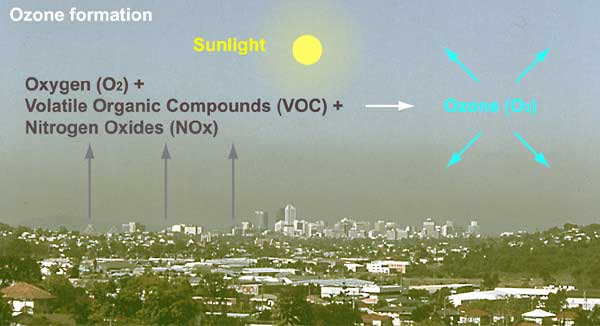
3.1 Ozone (O3) is formed when other pollutants react under the action of light. It is mainly formed outdoors. More...
3.2 Outdoor ozone levels vary across city areas and times of the day, with peaks in the afternoon. Ozone concentrations indoors are generally 50% lower than those outdoors. Indoor sources of ozone include photocopiers and electrostatic air cleaners. More...
3.3 Unlike levels of other air pollutants, ozone levels tend to be lower in urban polluted areas. This is because ozone disappears when it reacts with other pollutants, such as nitric oxide (NO). At places and times when peak levels occur, short-term exposure can temporarily affect the lungs, the respiratory tract and the eyes, and increase susceptibility to inhaled allergens. Since days with mildly elevated ozone levels are much more frequent than days with high peaks, their overall impact on public health may be expected to be greater. More...
4.1 Though the effects of ozone (O3) reductions on public health have seldom been evaluated independently from other air pollutants, it was noted that O3 reductions may have some beneficial effects on lung function and asthma. More...
4.2 It is recommended that a guideline for short-term exposure to ozone be set based on an 8-hour averaging time. Because of insufficient information, no long-term guideline has been recommended yet. More...
4.3 Current WHO Air quality guidelines describe the relationships between exposure to ozone (O3) and various health effects, and they propose a guideline value for short-term (8-hour) exposure only. New scientific evidence justifies reconsidering these guidelines. More...
5.1 There are uncertainties linked to gaps in our knowledge about air pollution and the related health effects. In this study, uncertainties were taken into account but could not be quantified for all answers. It was stressed that, in accordance with the precautionary principle, uncertainties should not be taken as a cause for not acting if the potential risks are high and measures to reduce the risks are available at reasonable cost. More...
Examples of uncertainties related to this study:
5.2 A publication bias can occur when only certain types of results have been published. For example, results that show large effects that are statistically significant are more easily accepted for publication. More...
5.3 Uncertainties may arise when experimental studies and studies on human populations do not point in the same direction. For instance they may disagree whether thresholds exist below which ozone or PM have no effects. More...
5.4 For particulate matter, uncertainties remain regarding the precise contribution of different pollution sources to health effects, as well as regarding the precise contribution of the different components of particulate matter. More...
5.5 Some uncertainties arise in this study when analyzing results with different statistical methods. However, the links between air pollution and health remain, no matter which method of analysis is used. More...
5.6 There are uncertainties regarding regional differences in the effects of air pollution, due to variations in characteristics of populations, environments, and pollution mixes. More...
Population groups that have potentially increased vulnerability to effects of exposure to air pollutants are:
7.1 In setting standards to protect public health from the effects of air pollutants, the concept of thresholds may not be useful, because certain population groups are very sensitive, and effects are detected even at low levels.To enable the development of effective risk reduction strategies based on qualitative and quantitative knowledge, further data analysis and more comprehensive monitoring is recommended. More...
7.2 In addition to the pollutants discussed in this study, other aspects of air pollution should also be addressed in the development of air pollution policy in Europe. These include air pollutants such as carbon monoxide (CO), sulphur dioxide (SO2), persistent organic pollutants (POP), certain metals, certain volatile organic compounds, and nitrogen trichloride. The combined effects of the urban air pollution mix is also an important issue that remains unresolved. More...
7.3 Evidence of the health effects of air pollution at levels currently common in Europe has grown stronger over the past few years, and is sufficient to recommend further policy action to reduce emissions of particulate matter, ozone, and nitrogen dioxide. More...



This summary is free and ad-free, as is all of our content. You can help us remain free and independant as well as to develop new ways to communicate science by becoming a Patron!





 BECOME A PATRON!