

Languages:

Biodiversity is a contraction of biological diversity. It reflects the number, variety and variability of living organisms and how these change from one location to another and over time. Biodiversity includes diversity within species (genetic diversity), between species (species diversity), and between ecosystems (ecosystem diversity).
Biodiversity is important in all ecosystems, not only in those that are "natural" such as national parks or natural preserves, but also in those that are managed by humans, such as farms and plantations, and even urban parks. Biodiversity is the basis of the multiple benefits provided by ecosystems to humans.
Biodiversity is difficult to quantify precisely even with the tools and data sources that are available. But precise answers are seldom needed to sufficiently understand biodiversity, how it is changing, and the causes and consequences of such change.
Various ecological indicators, such as the number of species in a given area, are used to measure different aspects of biodiversity. They form a critical component of monitoring, assessment, and decision-making and are designed to communicate information quickly and easily to policy-makers. However, no single indicator captures all the dimensions of biodiversity. More...
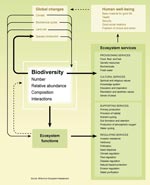
Linkages among Biodiversity, Ecosystem Services & Human Well-being
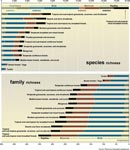
Measuring Biodiversity: More than Species Richness
Life, and thus biodiversity, is essentially everywhere on Earth's surface and in every drop of its bodies of water. This is seldom appreciated because most organisms are small or invisible to the naked eye, and many are rare, short-lived or hidden.
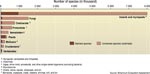
Documenting biodiversity is difficult. The best known dimension of biodiversity is the classification of animals and plants into species, which mainly focuses on animals observable to the naked eye, temperate ecosystems, and aspects that are used by people. Only 1.7-2 million of the 5 to 30 million species that are thought to exist on Earth have been identified so far. More complete inventories are badly needed to correct for this deficiency. More...
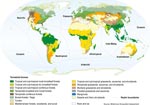
1.2.1 While available data is often insufficient to provide an accurate picture of the extent and distribution of all components of biodiversity, they allow useful approximations. For instance, useful species distribution data is available for some areas, such as the temperate regions of North America, Europe and Asia, for instance for some birds and mammals. Indicators can be used to build on these inventories. Biomes are ecological communities of organisms associated with particular climatic and geographic conditions, such as deserts, grasslands, and tropical rainforests. Studying them can provide a broad picture of the various different ecological functions within a community and of its biological diversity.
Earth can also be divided into eight biogeographic realms which share a broadly similar biological evolutionary history. Between realms there is a marked difference in species composition. More...
1.2.2 Based on present knowledge of how biodiversity changes over time, rough estimates can be made of the rates at which species become extinct. The history of life is characterized by considerable change. Fossils allow to estimate the extinction rate of species that were abundant and large enough to have left a fossil trace. Current rates of extinction are discussed in Question 3.
The dynamics of changes in natural systems and of human responses are quite different. This is due to the fact that it takes some time for changes in an ecosystem to become apparent, that feedbacks between socioeconomic and ecological systems are complex, and that it is difficult to predict thresholds at which sudden or rapid changes will occur.
Crossing a threshold may cause rapid substantial changes in biodiversity and in the benefits the ecosystem can provide to humans. This has been observed in open aquatic ecosystems when a temperature threshold was crossed or when resources were overexploited. For example, an increased nutrient input can cause the shift of coral dominated reefs to an algal dominated ecosystem, which is less diverse and productive from a biological point of view. Invasive species can also act as triggers for dramatic changes in ecosystem structure. For example, the introduction of a carnivorous jellyfish-like animal in the Black Sea caused the loss of 26 major fisheries species and has contributed to the subsequent growth of the oxygen-deprived "dead" zone. More...
Ecosystem services are the benefits obtained by people from ecosystems. These include:
Biodiversity plays an important role in the way ecosystems function and in the services they provide. Species composition matters as much or more than species richness when it comes to ecosystem services, since the functioning of an ecosystem, and thus its ability to provide services to humans, is strongly influenced by the ecological characteristics of the most abundant species, not by the number of species.
The local loss of an essential species can disrupt ecosystem services for a long time. Changes in the interactions between species can also lead to negative impacts on ecosystem processes.
Table: Ecological Surprises Caused by Complex Interactions
On land, biodiversity affects key ecosystem processes such as the production of living matter, nutrient and water cycling, and soil formation and retention. All of these govern and ensure supporting services that are necessary for the production of all other ecosystem services. Differences between regions in terms of ecosystem processes are driven mostly by differences in climate, in resource availability, and in other external factors, and not by differences in species richness. Though losses of biodiversity may have only small impacts on an ecosystem in the short term, they may reduce its capacity to adjust to changing environments in the future.
Biodiversity also affects regulating services that regulate ecosystem processes, climate, floods, disease, and water quality:



This summary is free and ad-free, as is all of our content. You can help us remain free and independant as well as to develop new ways to communicate science by becoming a Patron!

 BECOME A PATRON!