

Languages:

DIDP and DINP are viscous, oily liquids that are soluble in fat and not very soluble in water. They are not very volatile so they do not vaporise readily into the atmosphere.
Under the European Union classification system that applies to labelling of chemicals in commerce, DIDP and DINP are not classified as “dangerous to the environment or human health.
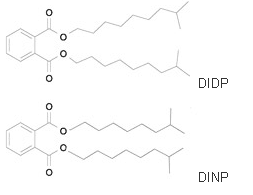
The acronym DIDP refers to di-isodecyl phthalate. It is a mixture of closely related substances known as isomer which have two carbon chains that can be 9 to 11 carbons long, with the largest portion having 10 carbon atoms in the side chains. The acronym DINP similarly refers to di-isononyl phthalates which is a mixture of isomers that have alkyl chains form 8 to 10 carbons long, but the largest portion of the mixture have chains composed of 9-carbons. The close similarities between DIDP and DINP, both in their properties and their end uses, means that they will be treated together in the present study. More...
See overview table for DIDP, DINP and DBP



This summary is free and ad-free, as is all of our content. You can help us remain free and independant as well as to develop new ways to communicate science by becoming a Patron!

 BECOME A PATRON!