

Languages:


Context - Diisodecyl-phthalate (DIDP) and Diisononyl-phthalate (DINP) are two closely related substances that are mainly used as additives in plastics to make them more flexible.
Their widespread use in everyday products, from floorings and shoe soles to toys has raised some concerns about their safety. Do DIDP and DINP pose a risk to health or the environment?


This Digest is a faithful summary of two leading scientific consensus reports produced in 2003 by the European Chemicals Bureau (ECB): "
Phthalates are widely used as additives in a range of plastics and other materials that are found in many consumer products. They make plastics, such as PVC, soft and flexible. They are not chemically bound to plastics, so they can be released from consumer products into the environment. There is public concern about phthalates because of their widespread use and occurrence in the environment as well as their potential effects on human health.
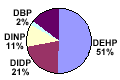
There is a wide range of different phthalates, which each have specific properties, uses, and health effects. In the European Union, five of the most widely used phthalates have been reviewed by the European Chemicals Bureau (DEHP, DBP, DINP, DIDP, and BBP).
By 2004, EU Risk Assessment Reports had been published for three of these phthalates: DIDP, DINP, and DBP; assessements which have been summarised by GreenFacts. Because of the strong similarities between the first two phthalates, they are described together. More...
DIDP and DINP are acronyms that each refer to certain mixtures of phthalates.
They have a common core structure with two long chains of molecules attached to the core. Most of these chains contain 10 carbon atoms in the case of DIDP, and 9 carbon atoms in the case of DINP. The arrangement of the molecules in the chains can differ and this is why DIDP and DINP are mixtures of closely-related substances.
DIDP and DINP are sticky, oily liquids. They are soluble in fat and not very soluble in water. More...
In 1994, over 200 000 tonnes of DIDP and 107 000 tonnes of DINP were produced annually in the European Union and production is expected to increase further.
They are used mainly as a plasticiser in PVC that is used to make film, sheeting, coated products, flooring, roofing, wall coverings, hoses, tubing, wires, cables, injection moulded shoe soles, car undercoating and sealants.
They are also used in vinyl resins other than PVC, in cellulose ester plastics as well as in adhesives, paints and printing inks. More...
Although DIDP and DINP are mixtures and each component can behave slightly differently in the environment, an overall picture can be drawn. More...
3.1 DIDP and DINP present in the environment can remain for a long time in soil and sediment. They can also concentrate in organisms living in water. More...
3.2 Most of the DIDP and DINP released into the general environment results from the use and disposal of PVC products containing them. DIDP and DINP can go into waste water, surface water and into air. More...
3.3 Local concentrations in the environment are particularly high around industrial sites where DIDP and DINP are either produced or used to make plastics and other products. At those sites concentrations of DIDP and DINP in water, sediment and soil are highest. More...
3.4 DIDP and DINP do not appear to have adverse effects on organisms in the environment. They are not toxic to microbes, plants or animals. More...
3.5 Despite the presence of DIDP and DINP in the environment, it is concluded that:
Exposure of humans may occur because DIDP and DINP are present in the general environment, in the workplace and in consumer products. More...
4.1 The highest exposures can occur in certain workplaces where DIDP, DINP, or products that contain them are produced or used. More...
4.2
Exposure of the general public is about 50 times lower than workplace
exposure. For infants, the level of exposure varies depending on whether
they have contact with plastic toys and baby care equipment containing
DIDP or
DINP. If they have contact with
such toys their exposure can be much greater.
More on consumers exposure...
DIDP and DINP are absorbed well when swallowed or breathed in, but are poorly absorbed through the skin.
In laboratory animals the main effects of DIDP and DINP are on the liver and include cancer. Humans are thought to be much less sensitive to these liver effects and the cancer is caused by a mechanism which is only seen in rodents and not in humans. DIDP and DINP also affect survival of rat offspring.
DIDP does not appear to interfere with hormones and reproduction, but DINP may have some impact on male hormones. More...
6.1 When human exposures are compared with the lowest amounts needed to cause effects in laboratory animals, the margin of safety is sufficient for workers not to be considered at risk. More...
6.2 Exposure of the general public is lower than that of workers, thus adults and children above the age of three are not considered to be at risk.
In the worst case scenario for newborns and infants, which assumes that all the phthalates in toys and baby equipment are DIDP, the margin of safety is not sufficiently protective.This is because infants can absorb phthalates when putting toys into their mouth. If toys are excluded from exposure estimates, then infant exposures are not of concern.
For DINP, the margins of safety are considered sufficient, even for infants exposed to toys containing DINP. More...
The European Union Risk Assessment Report on DIDP and DINP (the source of the present summary) concluded that there is no need for further information or testing, or for further risk reduction measures beyond those already taken, except to limit risks should DIDP be used in toys.
The Scientific Committee on Toxicity, Ecotoxicity and the Environment has commented on the European Union Risk Assessment Report on DINP. It did not agree with several of the conclusions about environmental effects and considers that more research is necessary. More...
Phthalates have played an important role in the creation of plastics and other materials that have many versatile uses in industry, in medicine and in consumer products.
In view of more recent research, raising concerns about possible environmental and health effects, the risks of exposure to phthalates are being kept under close review by national and international bodies.
The most recent EU reviews on DIDP, DINP and DBP conclude that:
Other phthalates are currently being assessed by the European Chemicals Bureau.
GreenFacts comment:
Other EU reviews are currently underway and the information will be posted on this website as soon as it becomes available:


Introduction: What are phthalates?

This summary is free and ad-free, as is all of our content. You can help us remain free and independant as well as to develop new ways to communicate science by becoming a Patron!




 BECOME A PATRON!