

Languages:

The source document for this Digest states:
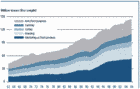
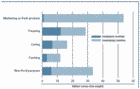
Source: FAOIn 2006, more than 110 million tonnes (77 percent) of world fish production was used for direct human consumption. Almost all of the remaining 33 million tonnes was destined for non-food products, in particular the manufacture of fishmeal and fish oil (see Table 1 on page 3). If China is excluded, the quantities were 72 million tonnes and 20 million tonnes, respectively (see Table 2 on page 4 and Figure 2 on page 5). In 2006, more than three-quarters of China’s reported fish production was destined for human consumption, with the remaining amount (an estimated 13 million tonnes) reduced to fishmeal and allocated to other non-food uses, including direct feed for aquaculture. In China, aquatic products are traditionally most commonly distributed to the domestic market in live and fresh form. However, in recent years, processing has seen significant growth. For example, in 1996, total processed aquatic products for human consumption accounted for 20 percent of total domestic aquatic production, while in 2006 this share reached 33 percent. In the last few years, more value-added products have been made in China, including retail packs. China processes not only domestic production but also imported fish into an array of fish products, including salted, dried, smoked and various preserved fish products for both domestic and export markets. The Chinese reprocessing industry is labour-intensive and traditionally works on low margins, which have recently tended to narrow further with escalating costs for raw materials.
In 2006, 48.5 percent of the fish destined for human consumption was in live and fresh form, which is often the most preferred and highly priced product form. Fifty-four percent (77 million tonnes) of the world’s fish production underwent some form of processing. Seventy-four percent (57 million tonnes) of this processed fish was used for manufacturing products for direct human consumption in frozen, cured and prepared or preserved form, and the rest for non-food uses (Box 3). Freezing is the main method of processing fish for food use, accounting for 50 percent of total processed fish for human consumption in 2006, followed by prepared and preserved (29 percent) and cured fish (21 percent) (Figure 28).
Fish is one of the most versatile food commodities and can be utilized in a great variety of ways and product forms. It is generally distributed as either live, fresh, chilled, frozen, heat-treated, fermented, dried, smoked, salted, pickled, boiled, fried, freeze-dried, minced, powdered or canned, or as a combination of two or more of these forms. However, fish can also be preserved by many other methods. The trade in live fish is special. In some parts of Southeast Asia, and particularly in China, the trade is not formally regulated but based on tradition. However, in markets such as the EU, the trade in live fish has to comply with requirements inter alia concerning animal welfare during transportation.
In many developing countries with tropical ambient temperatures, quality deterioration and significant post-harvest losses occur because of inadequate use of ice, long supply chains, poor access to roads and electricity, and inadequate infrastructure and services in physical markets. Market infrastructure and facilities are often limited and congested, increasing the difficulty of marketing perishable goods. Owing to these deficiencies, together with well-established consumer habits, fish production is utilized in such countries mainly in live/fresh form (representing 60.1 percent of fish destined for human consumption in 2006) or processed by smoking or fermentation (10.0 percent in 2006). However, in the last few years, there has been a slight increase in the share of frozen products in developing countries (19 percent in 2006, up 7.3 percent since 1996), with a more significant rise in prepared or preserved forms (11.1 percent in 2006, up 41 percent since 1996). In developed countries, the bulk of fish used for human consumption is in frozen and prepared or preserved forms. Freezing is still prominent as the primary form of production, with a proportion that has been constantly increasing, and it accounted for 42 percent of total production in 2006 (Figure 29). Processors of traditional products, in particular of canned products, have been losing market shares to suppliers of fresh and frozen products as a result of long-term shifts in consumer preferences.
The utilization and processing of fish production have diversified significantly in the last two decades, particularly into high-value fresh and processed products, fuelled by changing consumer tastes and advances in technology, packaging, logistics and transport. These changes include improvements in storage and processing capacity, together with major innovations in refrigeration, ice-making, and food-packaging and fish-processing equipment. Vessels incorporating these improved facilities and able to stay at sea for extended periods have been built. This has permitted the distribution of more fish in live or fresh form. Moreover, improved processing technology enables higher yields and results in a more lucrative product from the available raw material.
In developed countries, value-added innovation is mainly focused on increased convenience foods and a wider variety of high value-added products, mainly in fresh, frozen, breaded, smoked or canned form. These necessitate sophisticated production equipment and methods and, hence, access to capital. The resulting fish products are commercialized as ready and/or portion-controlled, uniform-quality meals.
In developing countries, and supported by a pool of cheaper labour, processing is still focused on less sophisticated methods of transformation, such as filleting, salting, canning, drying and fermentation. These traditional, labour-intensive fish-processing methods are a means for providing livelihood support for large numbers of people in coastal areas in many developing countries. For this reason, they are likely to continue to be important components in rural economies structured to promote rural development and poverty alleviation.
However, in many developing countries, fish processing is evolving. There is a trend towards increased processing. This may range from simple gutting, heading or slicing to more advanced value-addition, such as breading, cooking and individual quick-freezing, depending on the commodity and market value. Some of these developments are driven by demand in the domestic retail industry or by a shift in cultured species, for example, the introduction of Penaeus vannamei in Asia. These changes reflect the increasing globalization of the fisheries value chain, with the growth of international distribution channels controlled by large retailers. More and more producers in developing countries are being linked with, and coordinated by, firms located abroad. The increasing practice of outsourcing processing at regional and world levels is very significant, its extent depending on the species, product form, and cost of labour and transportation. For example, whole fish from European and North American markets are sent to Asia (China in particular, but also India and Viet Nam) for filleting and packaging, and then re- imported. In Europe, smoked and marinated products are being processed in Central and Eastern Europe, in particular in Poland and in the Baltic countries. The further outsourcing of production to developing countries is restricted specifically by sanitary and hygiene requirements that can be difficult to meet. At the same time, processors are frequently becoming more integrated with producers, especially for groundfish where large processors in Asia, in part, rely on their own fleet of fishing vessels. In aquaculture, large producers of farmed salmon, catfish and shrimp have established advanced centralized processing plants to improve the product mix, obtain better yields and respond to evolving quality and safety requirements in importing countries. In many developed countries, processors are often facing reduced margins owing to increased competition from low-cost processors in developing countries. They are also experiencing increasing problems linked to the scarcity of domestic raw material because of declining stocks and the need to import fish for their business.
Fish plays an important role not only in terms of its use for direct human consumption but also in the production of animal feeds, particularly fishmeal. About one-quarter of world fish production is destined for non-food products, with the bulk being converted into fishmeal and fish oil. The remainder, mainly consisting of low- value fish, is largely utilized as direct feed in aquaculture and livestock. In 2006, the quantity of fish used as raw material for fishmeal was about 20.2 million tonnes, down 14 percent on 2005 and still well below the peak levels of more than 30 million tonnes recorded in 1994. The decrease in fishmeal production in the past decade has been irregular, its considerable fluctuations mainly reflecting annual variations in catches of small pelagics, especially anchoveta.
Another emerging application of fish, crustaceans and other marine organisms is as a source of bioactive molecules for the pharmaceutical industry. Chitin from shrimp and crab shells is already being used in the pharmaceutical industry. Chitin and chitosan have wide-ranging applications in many areas such as water treatment, cosmetics and toiletries, food and beverages, agrochemicals and pharmaceuticals. Japan is the largest market (20 000 tonnes) for chitin-derived products. Biomedical products from wastes derived from the fish-processing industry (e.g. skin, bones and fins) are attracting considerable attention from industry. Fish skin as a source of gelatine has attracted interest after bovine spongiform encephalopathy (BSE) and some religious requirements prompted a search for alternatives to mammalian sources of gelatine. It is estimated that about 2 500 tonnes of fish gelatine was produced in 2006. Similarly, fish collagen has advantages over bovine collagen in the pharmaceutical industry. Carotenoids and astaxanthins are pigments that can be extracted from crustacean wastes, and the pharmaceutical industry is now showing interest in seafood processing waste as a source of these important molecules. Fish silage and fish protein hydrolysates obtained from fish viscera are finding applications in the pet feed and the fish feed industries. A number of anticancer molecules have been discovered following research on marine sponges, bryozoans and cnidarians. However, following their discovery, for reasons of sustainability, these molecules are not extracted from marine organisms directly, but are chemically synthesized. Another approach being researched is aquaculture of some sponge species.
Box 3: Fish utilization
An important feature of the fish-processing industry is that, while the operations are mostly small to medium scale, there is enormous diversity in the species of fish handled. For each type of processing, the fish can be prepared in several ways, from manual methods to fully automated operations, and then packaged in a wide variety of ways depending on the location and market demand. The various levels of progress and scales of operation available in the world increase the differences between species. What may be appropriate in an industrialized fishery is often not suitable for a small-scale artisanal fishery in a developing country. Furthermore, fish preservation and processing may vary according to species. Each of the many thousands of fish species has its own characteristic composition, size, shape and intrinsic chemistry. Fish is very perishable and several chemical and biological changes take place immediately after capture. Fish requires careful handling and preservation, special facilities such as cold storage and refrigerated transport, and rapid delivery to consumers. Therefore, the research and development of post-harvest systems for handling raw material are important to developing appropriate measures to: (i) increase its shelf- life; (ii) reduce physical, organoleptic (sensory) and nutritional losses; and (iii) preserve the quality and safety of the finished products. This is important for ecological, social and economic reasons – to safeguard consumer health and food security and to ensure the sustainability of the industry.
Source & ©: FAO Fisheries – The State of World Fisheries and Aquaculture, 2008
PART 1:World review of fisheries and aquaculture, Fish utilization,
p. 42-45



This summary is free and ad-free, as is all of our content. You can help us remain free and independant as well as to develop new ways to communicate science by becoming a Patron!

 BECOME A PATRON!